Artist Residencies
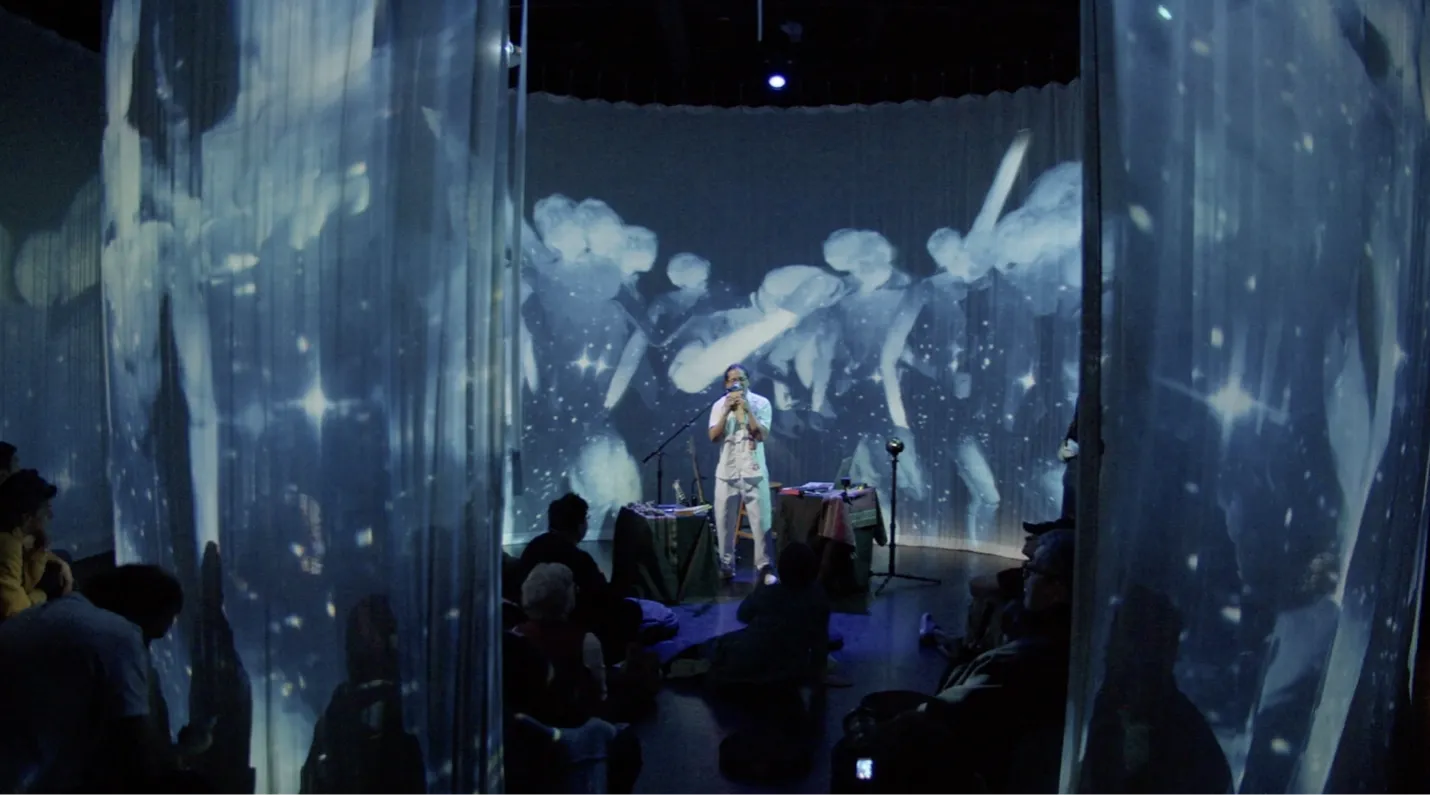
CAPTION: Ati Cachimuel Live Performance of Yana: An Andean Journey into Darkness at the Advanced Computing Center for the Arts and Design Motion Lab, April 23, 2024.
“Our mission as artists, musicians and writers is to continue to adapt to this world so that we do not become strangers to it.”
Ati Cachimuel
The Global Arts + Humanities (GAH) was founded on the premise that the most consequential intellectual work happens in spaces where disciplines and their differences meet. Central to this premise is the understanding that artistic practice, academic inquiry, and technological advances can work together and produce knowledge strengthened by their diversity. GAH’s artist residencies fund such cross-disciplinary exchange: sustained, resource-intensive partnerships that pair an artist’s vision with the technology and research infrastructure of The Ohio State University.
K’acha Willaykuna: Indigenous Performance Past, Present, and Emerging—a project funded by a GAH Collaborative Centers Grant—brings together musician and composer Ati Amaru Cachimuel Amaguaña, Ohio State’s Advanced Computing Center for the Arts and Design (ACCAD), and the Center for Latin American Studies. An interdisciplinary team of 32 faculty, students, and staff, guided by lead faculty Michelle Wibbelsman (Department of Spanish and Portuguese) and Norah Zuniga-Shaw (ACCAD), worked with Cachimuel to build YANA: An Andean Journey into Darkness—an immersive sensory, visual, and auditory performance. YANA draws on Andean cosmology, traditional instruments, and spatial sound technology to emphasize Indigenous innovation, transformation, and collaboration.
“This is a personal story, but it represents an entire collective of people behind me.”
Ati Cachimuel
Building an Artist’s Vision
Beginning in autumn 2023, the team set out to realize Cachimuel’s vision for YANA. Drawing on his experiences growing up in the Andes and his Kichwa Otavalo ancestry and history, Cachimuel’s intention was to capture a lived experience rooted in that social and cultural context. During a two-week on-campus artist residency the team approached YANA as founded first in sound and composition, with technical elements built around that foundation. ACCAD’s SonicLab Dolby Atmos spatial audio tools and the Motion Lab’s motion-capture technology contributed to the performance’s sonic layering effect and striking 3D animations, while arts and humanities faculty and staff contributed dance performances and historical and cultural insights. The result merged new technologies with contemporary Indigenous performance rooted in traditional practices, culminating in a multimodal final performance.
YANA premiered April 23, 2024, in ACCAD’s Motion Lab, with Cachimuel performing at the center of a 360-degree projection space. By way of imagery, musical cadence, sensory elements, and repetition paired with the effects of immersive sound, all-encompassing projection, and stage and lighting production, the final performance of YANA drew listeners into a world that embraced an expanded notion of humanity in harmony with its surroundings. YANA is ultimately about connecting two worlds, two possibilities—the artistic and the technological, the past and the present, humanity and nature, the Indigenous and the non-Indigenous, the performer and the audience—and experiencing the contrasts and simultaneity of two things at once.
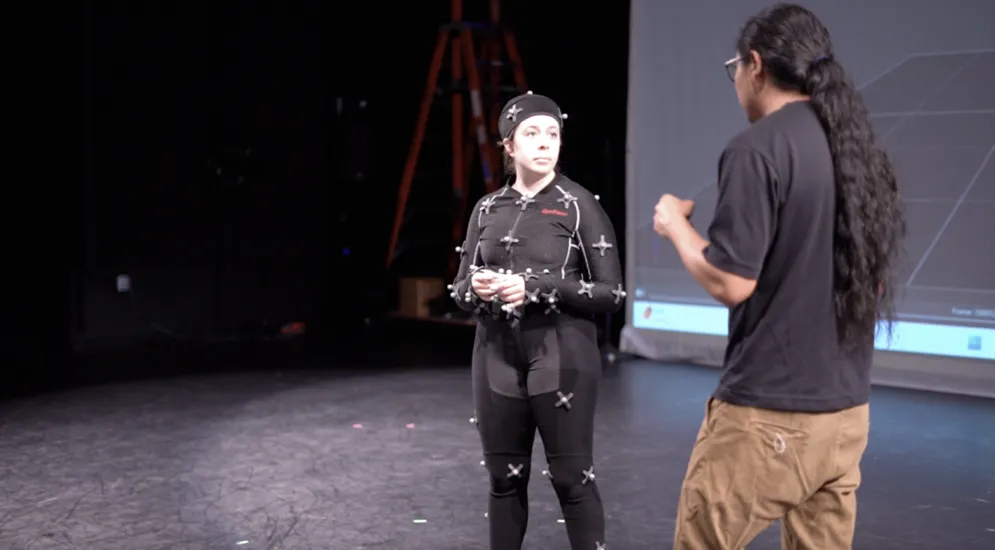
CAPTION: Ati Cachimuel and Dance Department student working with motion-capture technology at ACCAD Motion Lab.
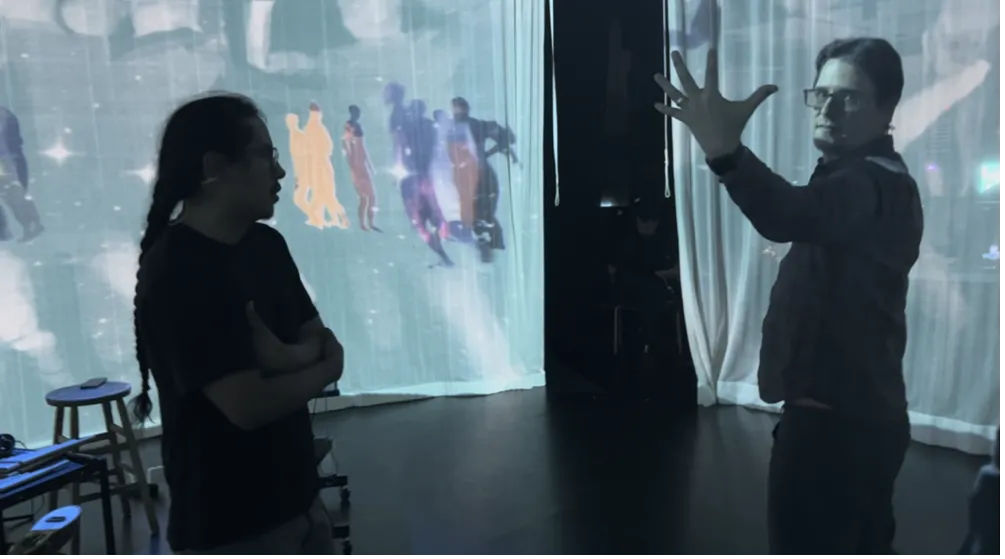
CAPTION: Ati Cachimuel working with Alex Oliszewski (Theater, Film and Media Arts faculty) on stage production for YANA.
“Concepts such as incorporating Kichwa aesthetics into the composition—for instance, through the geometric patterns found in textiles—have broadened my vision and compositional language, allowing me to explore new musical textures and forms. This has opened up creative possibilities that place Kichwa culture within a contemporary academic context.”
Ati Cachimuel
Local and Global Impacts
Cachimuel’s residency fostered community building and interdisciplinary work beyond YANA itself. While in Ohio, Cachimuel’s artistic focus on lived experience led to collaborative, community-engaged events with Ohio State and local Columbus community members: The 2024 solar eclipse that plunged parts of Central Ohio into two whole minutes of darkness; an Andean-style peña (musical evening) with the Quechua Learning Community and Ohio State’s Andean Music Ensemble; trips to Serpent Mound in Peebles, Ohio and to the Great Circle Mound Earthworks in Newark, where the YANA team and Ohio State community members gathered for a predawn “unplugged” musical performance and ceremony; and an afternoon working with clay in the Department of Art, an exercise Cachimuel later described as slowing him down and grounding him against the pace of digital production.
Cachimuel’s work with Ohio State outlasted his artist residency. In summer 2025, members of the Ohio State team traveled to Otavalo, Ecuador, to present YANA for the Cachimuel family and their community at the natural spring beneath Cachimuel’s family home—the site that originally inspired the piece.
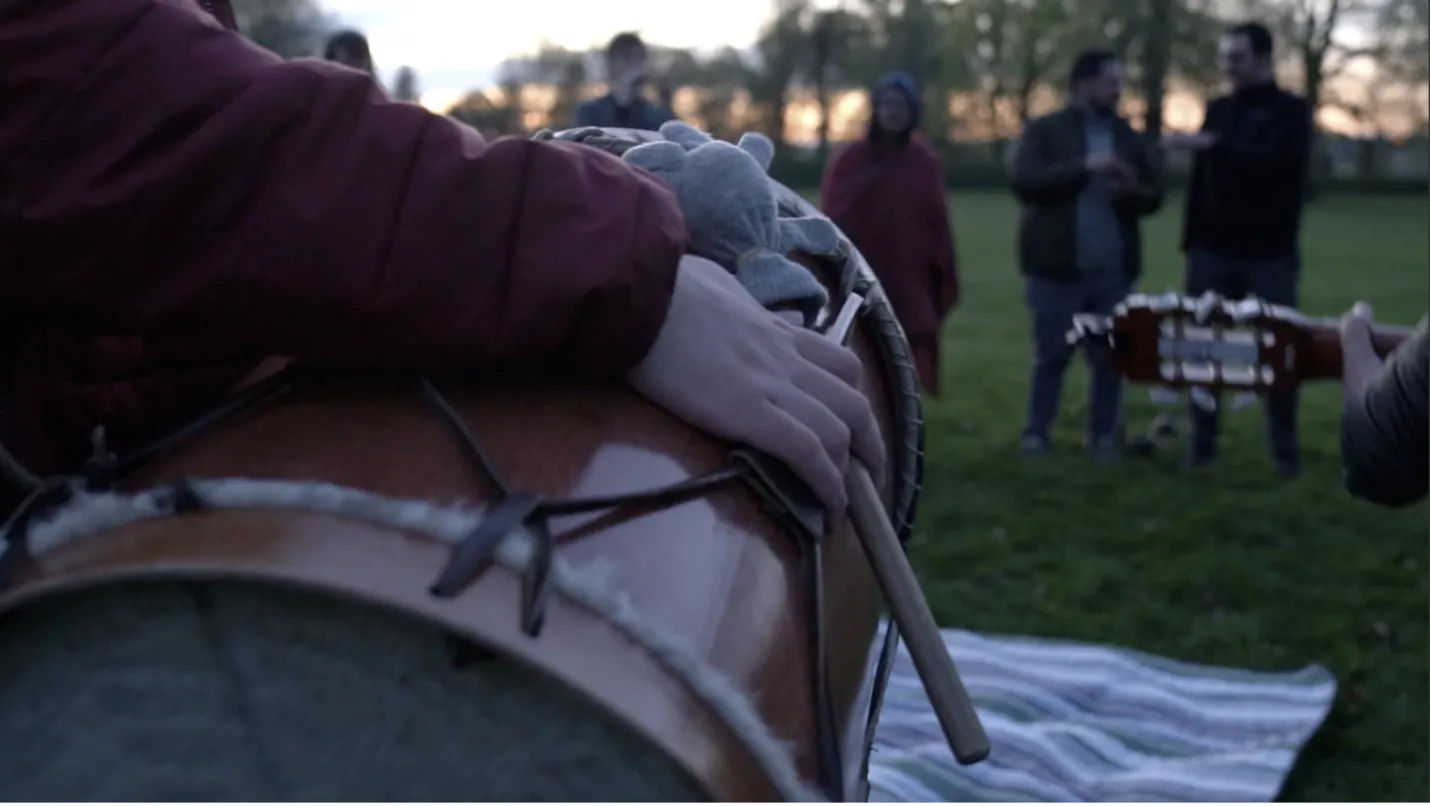
CAPTION: Students and collaborators gather at the Great Circle Mound in Newark for a predawn musical performance.
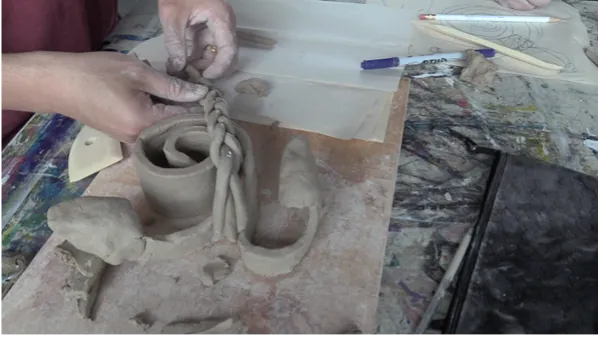
CAPTION: Ati Cachimuel and Ivan Ng (MFA student in the Art Department) work with clay.
Cross-Disciplinary Exchange
Reflecting on his experience at Ohio State, Cachimuel writes that “the collaboration and sensitivity of professionals skilled in cutting-edge technology have transformed YANA into an organic collaborative experience, demonstrating that Indigenous cultures can engage in a dynamic dialogue with the contemporary world and modern technological resources.” That understanding guided the YANA team to build systems responsive to Cachimuel’s artistic vision and its cultural context, instead of fitting his work into the existing systems specific to single disciplines or mediums. By broadening artistic possibilities, technology invites fresh insights and lines of inquiry that provide promising pathways for interdisciplinary and intercultural understanding. This project’s artist residency and its resulting networks, events, and experiences demonstrate what cross-disciplinary exchange can look like: technology in service of an artistic and cultural vision, and sustained collaboration outlasting a single performance or grant.