IMPACT STORY | Building Cross-Disciplinary Exchange: AI as Shared Inquiry
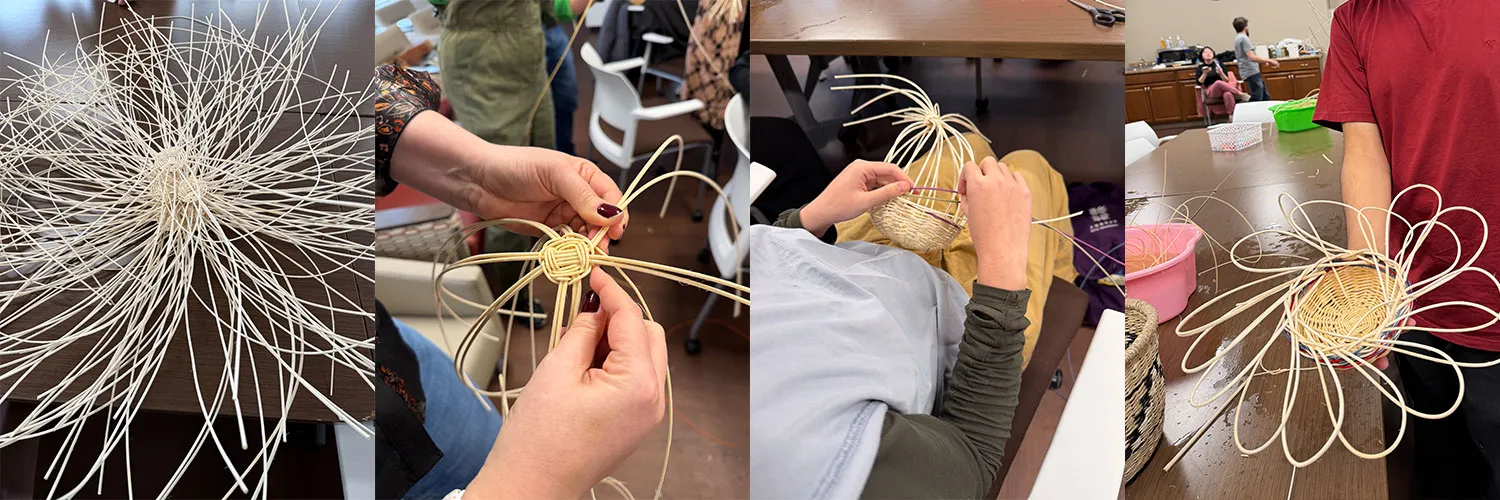
CAPTION: Attendees of Katherine Behar's workshop, "Pattern Reproduction or Pattern Recognition?," reverse-engineer baskets to learn how to recognize basket patterns and the making gestures those patterns represent. In this workshop, Behar built on her project, Inside Outsourcing, which takes the impossibility of robots making baskets as an opportunity to cultivate human/nonhuman cooperation.
By creating cross-disciplinary spaces that foster sustained engagement, the Global Arts + Humanities invites the university community to approach artificial intelligence not as a purely technological phenomenon, but as a constellation of entanglements. Such spaces enable artistic, humanistic and technical perspectives to converge to foster innovative and transformative inquiry. They pluralize modes of knowing — cultivating a research culture where complex subjects like AI can be examined critically and where discovery and knowledge circulate across disciplinary boundaries.
This commitment to cross-disciplinary exchange is exemplified by the Global Arts + Humanities’ Society of Fellows program which supports faculty, graduate and undergraduate research through fellowships, funding opportunities and programming aligned with an annual theme, which for 2025-26 is Creativity | Intelligence | Automation.
Artificial Intelligence: Propositions from the Arts + Humanities
In autumn 2025, the Society of Fellows program hosted the lecture series, Artificial Intelligence: Propositions from the Arts + Humanities. The series was designed to foreground the ethical obligations arising from the simulation of human intelligence and increased surveillance. Among the invited scholars and artists were Simone Browne (University of Texas-Austin), Katherine Behar (Baruch College) and Dennis Yi Tenen (Columbia University). Their contributions reveal AI as inseparable from the social, cultural and embodied contexts that give it form and function.
- Simone Browne, "And Bells On: Sound and Surveillance"
Simone Browne’s lecture, "And Bells On: Sound and Surveillance," examined doorbell cameras, the apps accompanying home monitoring systems and the ways artists engage with the afterlives of surveillance technologies, including devices such as Amazon’s Alexa. She examined how these everyday tools participate in broader systems of monitoring and control, tracing the logics they inherited from slavery and policing while engaging the ways in which artistic interventions render visible and challenge the enduring legacies of these systems.
- Katherine Behar, "Artisanal Intelligences"
Artist Katherine Behar's lecture, "Artisanal Intelligences," presented excerpts from Inside Outsourcing, a multimodal project that treats the impossibility of robots making baskets as an opportunity to explore human–nonhuman cooperation. Basketry’s resistance to automation underscores the value of what she calls “artisanal intelligences” — forms of tacit knowledge that cannot easily be abstracted into algorithmic procedures. In the accompanying workshop, "Pattern Reproduction or Pattern Recognition?," participants reverse engineered baskets in order to learn patterns and the making gestures those patterns represent.
- David Yi Tenen, "Manufacturing Intelligence"
Whereas Behar interrogated the limits of automation, Dennis Yi Tenen's lecture, "Manufacturing Intelligence," examined automation's inevitability, tracing how automated practices have long shaped the history of writing and technology. For Tenen, writing technologies have long enabled humans to share and delegate cognition, and AI continues this tradition of collective intellectual work. From this view, generative models are not autonomous agents but participants in the historical legacy of distributed authorship.
- Lauren Lee McCarthy, "Becoming Auto"
In spring 2026, artist Lauren Lee McCarthy will provide the final lecture in this event series, "Becoming Auto." McCarthy is an artist examining social relationships in the midst of automation, surveillance and algorithmic living, and she is a professor at UCLA Design Media Arts. McCarthy critiques the technological and social systems we’re building around ourselves. She explores reciprocal risk taking and vulnerability, as performer and audience are challenged to ask: Who builds these artificial systems? What values do they embody? Who is prioritized and who is targeted as race, gender, disability and class are programmatically encoded? Where are the boundaries around our intimate spaces? In the midst of ‘always on’ networked interfaces, what does it mean to be truly present?
Taken together, Browne, Behar, Tenen and McCarthy's work demonstrates that ethical engagement with simulated intelligences demands awareness of the historical forces and social contexts from which these systems emerge.