

Corinne Mitsuye Sugino (CMS) was interviewed by Graduate Administrative Assistant Anna Bogen (AB)
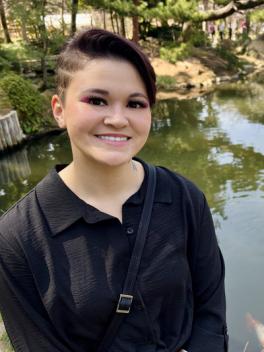
AB: How are cross-disciplinary perspectives or methods important to your current project?
CMS: My work is focused on the intersection of rhetoric and Asian American racialization. For example, my recent book project, Making the Human: Race, Allegory, and Asian Americans, considers how cultural, institutional and media narratives about Asian Americans shore up a limited understanding of what it means to be human. My next project, which I am working on now, deals with Asian American activist discourses in New York City in the 1960s and 1970s. I am looking at the rhetorical impact of Asian American activist newsletters and their relationship to what I describe as the model minority as a carceral logic. This approach requires that I take into account the institutional, systemic and physical impact of the prison regime and anti-racist organizing and its relationship to the material and cultural impacts of Asian American critique. As a result, I pull heavily not only from rhetorical studies but also Asian American studies, cultural studies and other related fields. I have found that studying the relationship between rhetoric and power benefits from (or arguably even necessitates) cross-disciplinary approaches. Racism, sexism, colonialism and social justice efforts do not operate in a vacuum. They are not limited to any singular arena of society (e.g. law, policy, popular culture, media, etc.) but work across them, so it requires an approach that is also capacious, interdisciplinary and flexible to understand them and produce new tools for thinking or imagining the world otherwise.
AB: What do you see as the major challenges of conducting cross-disciplinary research? What do you find most rewarding?
CMS: Of course there are a variety of challenges, but one that comes to mind is navigating multiple different approaches that can sometimes feel like they diverge significantly or use completely different vocabularies. Often, I find that this is both the most challenging and most rewarding part. It takes work to wade through those different vocabularies, and sometimes you find you are wading into a subfield or context that you don’t have as much prior experience with, but the topic you are interested in necessitates it to have an informed perspective. I think it is important to try to understand those subfields or contexts on their own terms, not only through the lens of what you are formally or informally trained in. That background will always influence you in some ways, and it will be part of what makes your perspective unique. But making an effort to understand how other approaches you engage ask different types of research questions or have a different research process can really open up your own work, in my opinion, and expand your perspective on things.
This is also true for engaging non-traditional forms of scholarship, including forms of creative expression, grassroots rhetorics, art, etc. that may not be considered “scholarly” in the traditional sense of your field but do have deeply meaningful expertise and insight that traditional scholarly methods and approaches might not. This is especially true, in my experience, if your research intersects with issues of power, oppression or justice. Disciplines “discipline” us so to speak, and that provides training but also creates a lens to understand the world. Those lenses draw our attention to some things, but also away from others (e.g. how we decide what information is meaningful or why it is meaningful). And sometimes those lenses can implicitly or unintentionally reproduce hierarchies, especially if the recognized or “canonical” experts in that field have predominantly been from privileged backgrounds. So, all of this is to say that cross-disciplinary research can be challenging but the fact it challenges us — to be open to different perspectives or unsettle certain molds of knowledge — is also its greatest strength.
AB: What ethical considerations drive your interests in Asian American rhetorics?
CMS: My research deals with anti-Asian narratives and Asian American rhetorics that challenge those narratives. As a result, the primary ethical consideration that drives my research is how it might contribute to producing more nuanced vocabularies for understanding, critiquing and dismantling hierarchies that harm Asian American communities or that use Asian Americans as rhetorical figures to harm other marginalized communities. At the same time, I am driven by the myriad ways that Asian American communities have worked to challenge, re-narrate or build solidarity against and beyond these systems of violence. I believe that scholars, students and interested readers can learn a lot from the successes, mistakes and knowledge produced by anti-racist Asian American rhetorics and histories.
At the same time, learning from anti-racist scholarship and Asian American rhetorics has profoundly impacted the way I think about the world and understand my own experiences. I am grateful for how it has transformed my research, community involvement and worldview in a way that is material and not simply intellectual or theoretical. So my hope is also that I might have an impact on other young thinkers, whether they are academics or not. That would be deeply meaningful to me.